03 / ERGODIC
A fully autonomous trading bot built by The Radius Lab.
Autonomous trading bot / CompletedThe Radius Lab project / Autonomous trading system
The Radius Lab projectA decision system that shows its working.
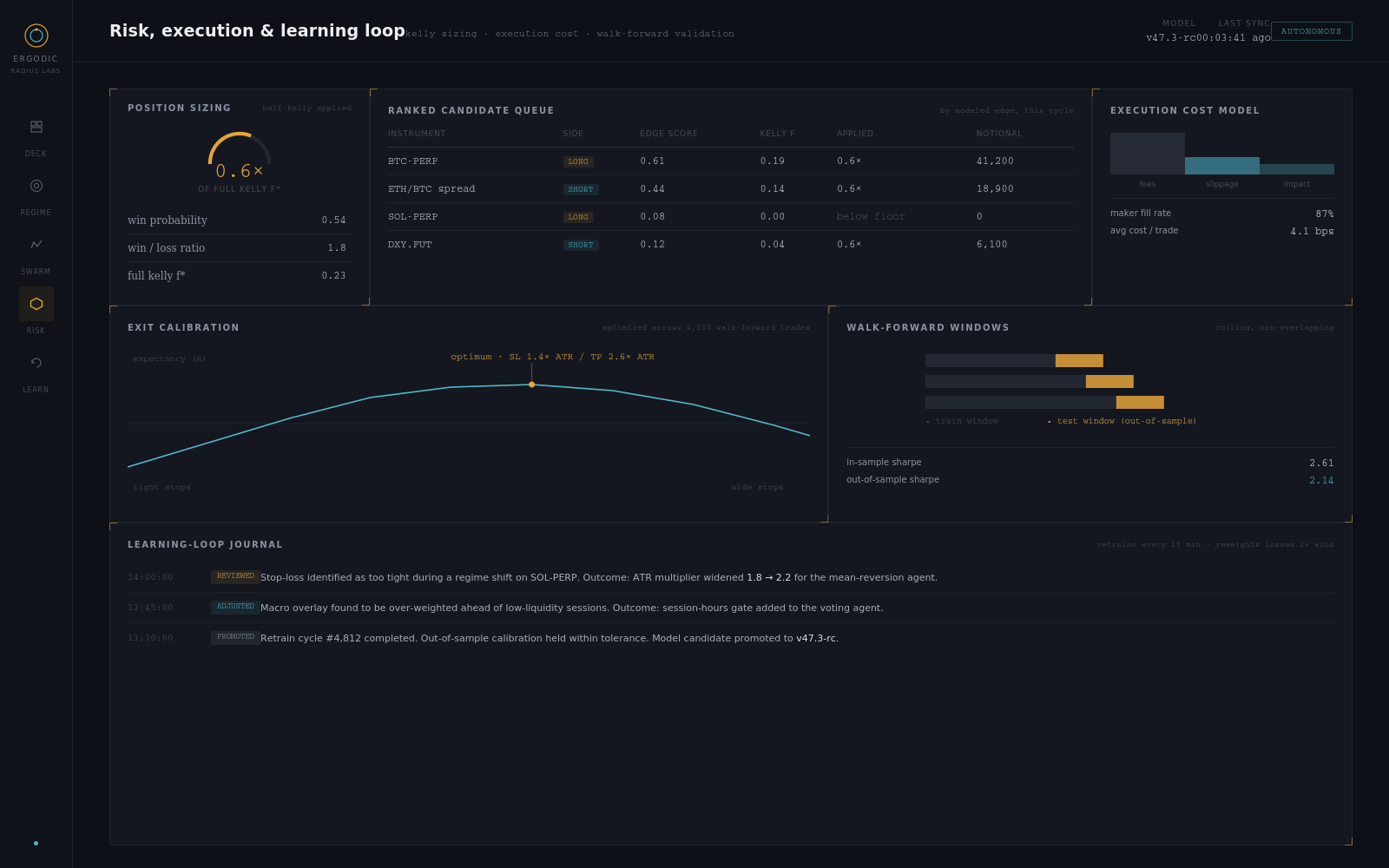
ERGODIC was built by The Radius Lab as an autonomous trading system whose sizing, execution, and learning logic can be examined as a chain—not just observed as an output.
- Built by
- The Radius Lab
- System focus
- Risk, execution & learning
- Review posture
- Explicit, modelled & bounded
Asset universe / 01
Multi-asset decision loop
Rather than evaluate a coin or symbol in isolation, ERGODIC resolves volatility-scaled sizing, covariance-aware exposure, liquidity-adjusted execution, and walk-forward recalibration into one constrained decision across its configured asset universe.
Methods atlas / Explicit assumptions
The theory is part of the interface.
ERGODIC makes its decision language legible: sizing, range, cost, covariance, and out-of-sample review remain visible where a system would otherwise become a single opaque score.
- Kelly / information rate
- Wilder / range analysis
- Markowitz / portfolio theory
- Almgren–Chriss / execution
Fractional Kelly sizing
f* = (bp − q) / bf applied = λ · f*J. L. Kelly / 1956The raw fraction is scaled before it reaches a position-size decision, keeping the sizing rule explicitly bounded.
Volatility-aware exits
ATRₜ = ((n−1)ATRₜ₋₁ + TRₜ) / nTRₜ = max(H−L, |H−Cₜ₋₁|, |L−Cₜ₋₁|)J. Welles Wilder / 1978A range-based volatility measure lets exit calibration adapt to current movement rather than a static threshold.
Cost-aware execution
C exec = fees + slippage + I perm + I tempmin E[C] + λ · Var(C)Almgren–Chriss / 2000Fees, slippage, and impact remain visible before a theoretical decision is treated as an executable action.
Walk-forward validation
train → test → rollw* ∝ Σ⁻¹μMarkowitz / 1952Rolling, non-overlapping windows keep calibration separate from out-of-sample review while portfolio context stays explicit.
Interface sequence / From context to action
Four views, one visible decision chain.
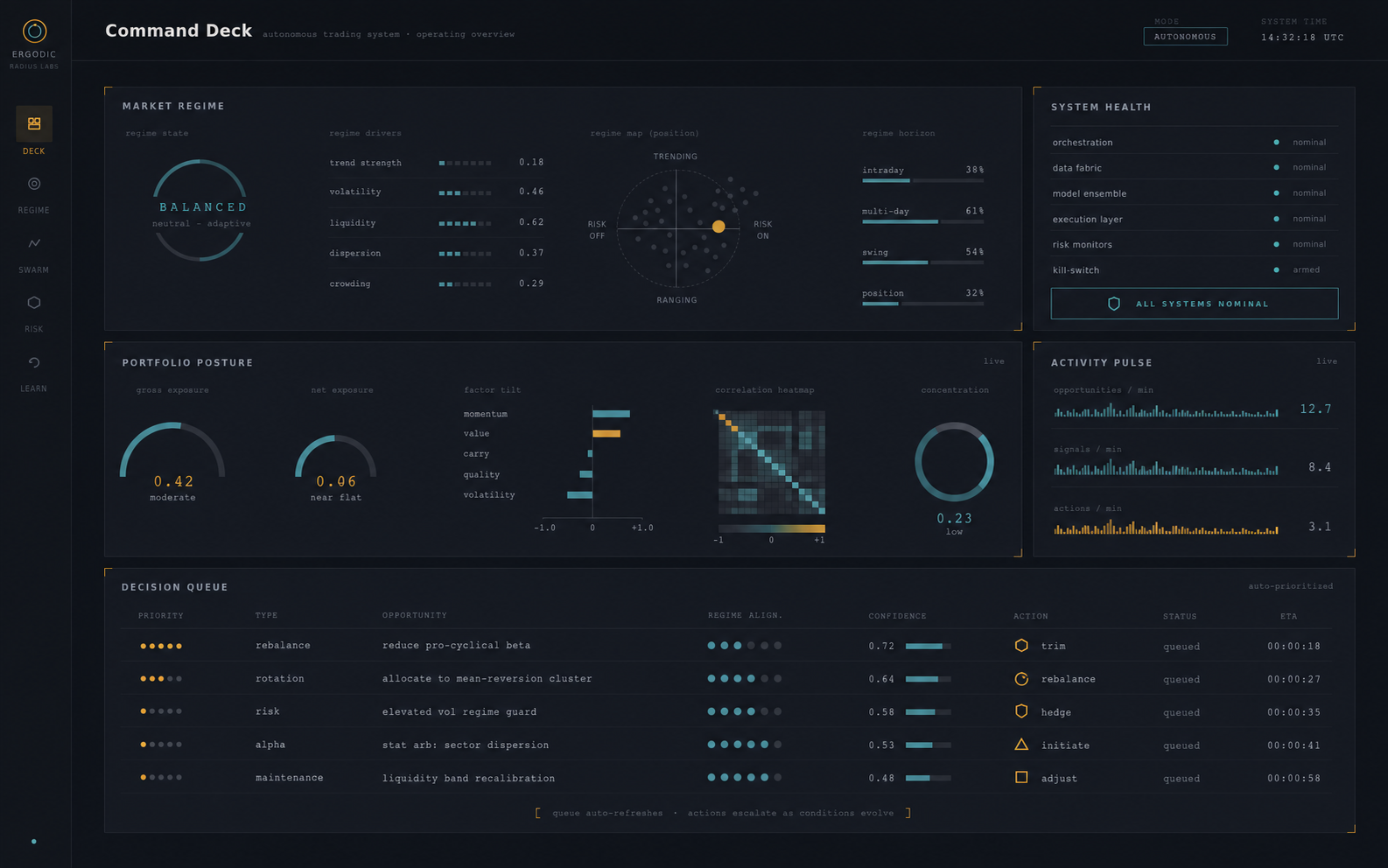
01 / Command Deck
A bounded operating view
A single surface makes the system’s posture, health, and queued decisions legible before an action is handed off.
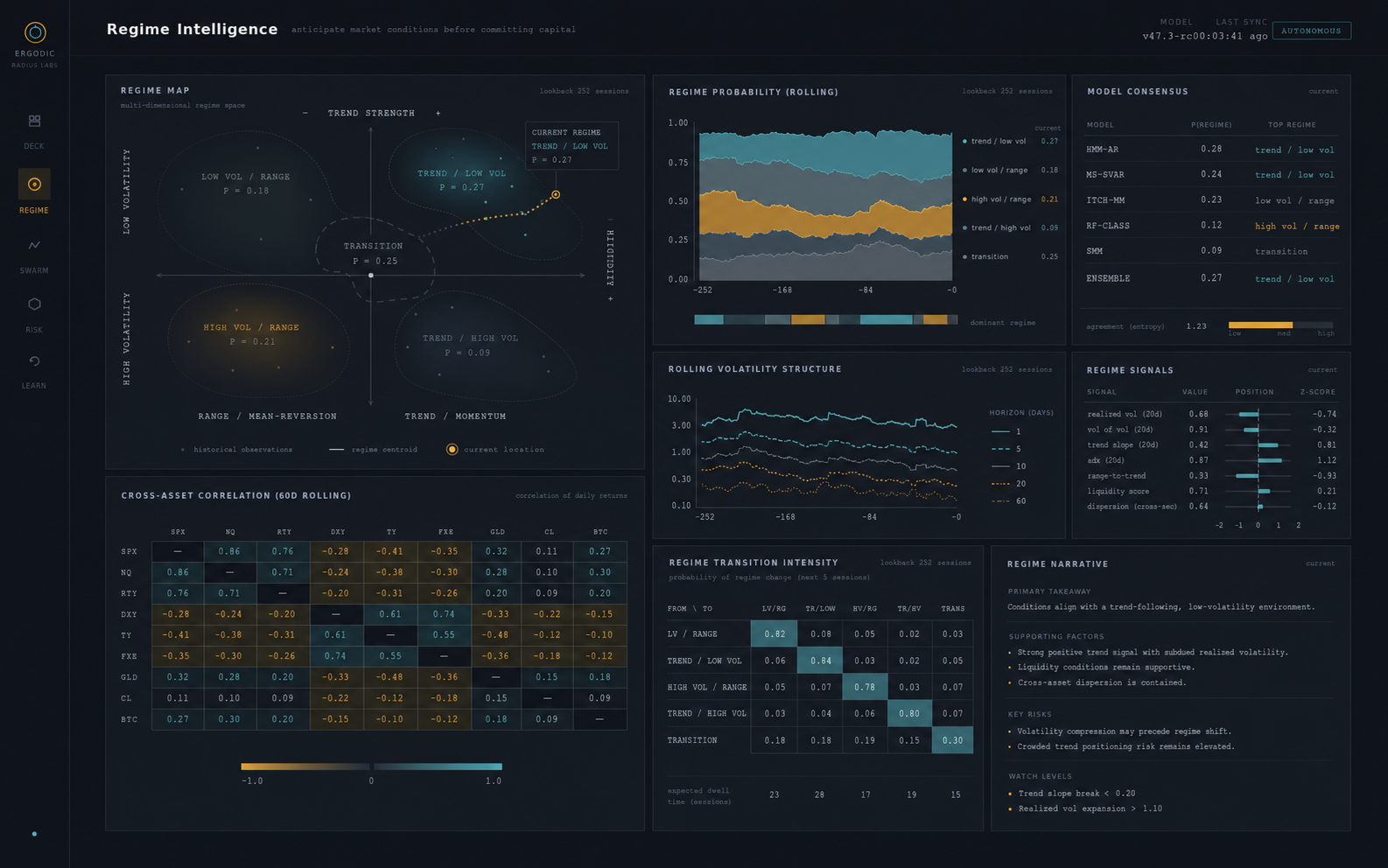
02 / Regime Intelligence
Classify before committing
Regime state, volatility structure, correlation, and model consensus appear together so a decision has a visible context.
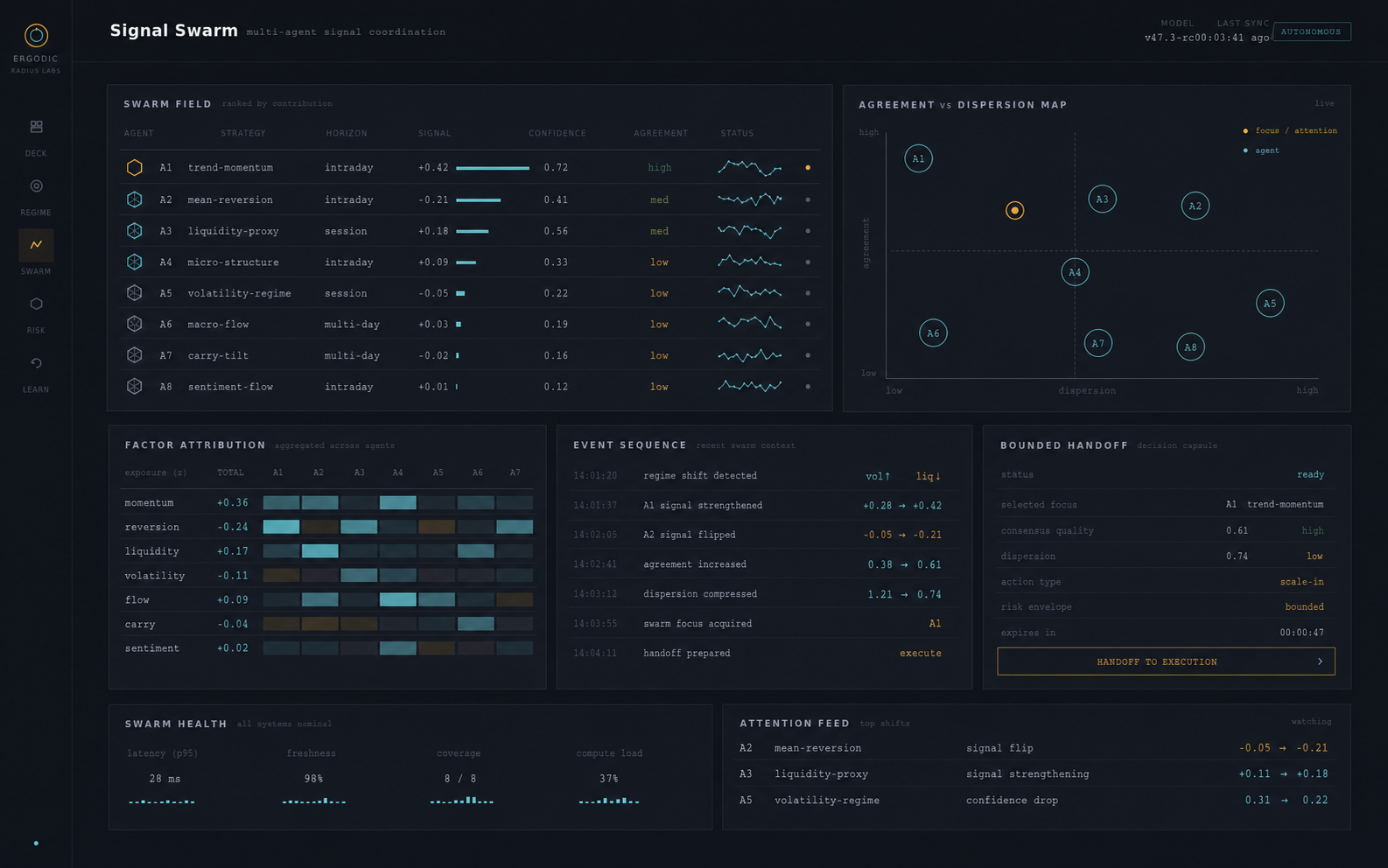
03 / Signal Swarm
Show the disagreement
Independent signals are not flattened into a black box: agreement, dispersion, attribution, and handoff state remain inspectable.